



How to Teach Present Tense in an Interesting Way?
How to Teach Present Tense in an Interesting Way?
Ever wondered why students still have problems understanding the present sentence after practicing it very much? Most of the time, it is not the subject itself that is the problem, but how the topic is introduced. Students begin to understand how the language functions in real-life situations when teachers teach present tense through simple sentences, daily activities and examples that students can relate to. Learning is easier and more fun when students start with what they see, hear and do every day instead of rules.
This method allows students to learn how to use the present sentence in their speech and writing without feeling pressured. By inventing innovative methods teachers can teach the present tense in a way that is clear, engaging and memorable.
Table of Content
Steps to Teach Present Tense
Teaching present tense becomes easier when lessons are broken into clear, learner-friendly steps.
These simple steps help learners use the present tense with confidence:
- Start with daily actions: Kids learn best through everyday activities such as eating, playing, reading and going to school.
- Explain types of present tense: Start with simple present, then introduce present continuous with simple examples like “She reads” and “She is reading.”
- Use visual and action cues: Pictures, flashcards and classroom activities helps kids learn understand faster.
- Practice through speaking activities: Encourage kids to form sentences about themselves and their surroundings to reinforce correct usage.
- Games and worksheets: Matching exercises, fill in the blank activities and sentence correction tasks, make practice more interesting.
- Check understanding regularly: Ask quick oral questions and short written exercises to help where kids need to improve.
The Grammar Teacher Training Course by Vidhyanidhi Education Society (Govt. Regd.) provides training in effective grammar teaching methods and helps teachers apply them easily in real classrooms.
How to Introduce Present Tense?
The best way to teach kids the present tense is to use it with them in real life. Being good at something is easy and quick when you have a step-by-step plan.
- Begin with easy activities: Use phrases that kids already know, like eat, play, write, or sleep. Say something short, like “I eat lunch” or “They play outside.”
- Explain the idea of “now” and “always”: Clarify that present tense is used for habits, facts, and actions happening regularly. This helps kids understand when to use it.
- Introduce sentence patterns slowly: Show subject–verb agreement using simple structures before moving to longer sentences.
- Add speaking and writing practice: Encourage learners to describe their daily schedule or write two to three simple sentences.
It helps them explain present tense topics clearly and confidently. Grammar Teacher Training Course by Vidhyanidhi Education Society (Govt. Regd.) helps teachers learn grammar easy and effective way to teach grammar.

Source: teachstarter
Effective activities to Teach Present Tense.
Learning present tense in real life is facilitated by appropriate classroom activities. Teaching present tense effectively is about practical application, clarity and repetition without being boring.
Practical steps to help learners understand the use of present tense and use it with confidence:
- Daily routine sentences: Eating, playing, reading, school, and going to school help students learn language easily. Students learn meaning and structure by applying sentences to real life.
- Picture description activity: Simple present first and then present continuous. Use simple examples such as “She reads” and “She is reading.”
- Role-play conversations: Pictures, flashcards, classroom activities helps kids learn quickly, especially young kids.
- Sentence correction games: Provide incorrect sentences and let learners identify and correct errors.
- Question–answer drills: Encourage learners to ask and answer questions in present tense for better fluency.
These methods make it easier to Teach-Present-Tense while keeping learners active, confident, and consistent in grammar use.
How to Teach Tenses in a Fun Way?
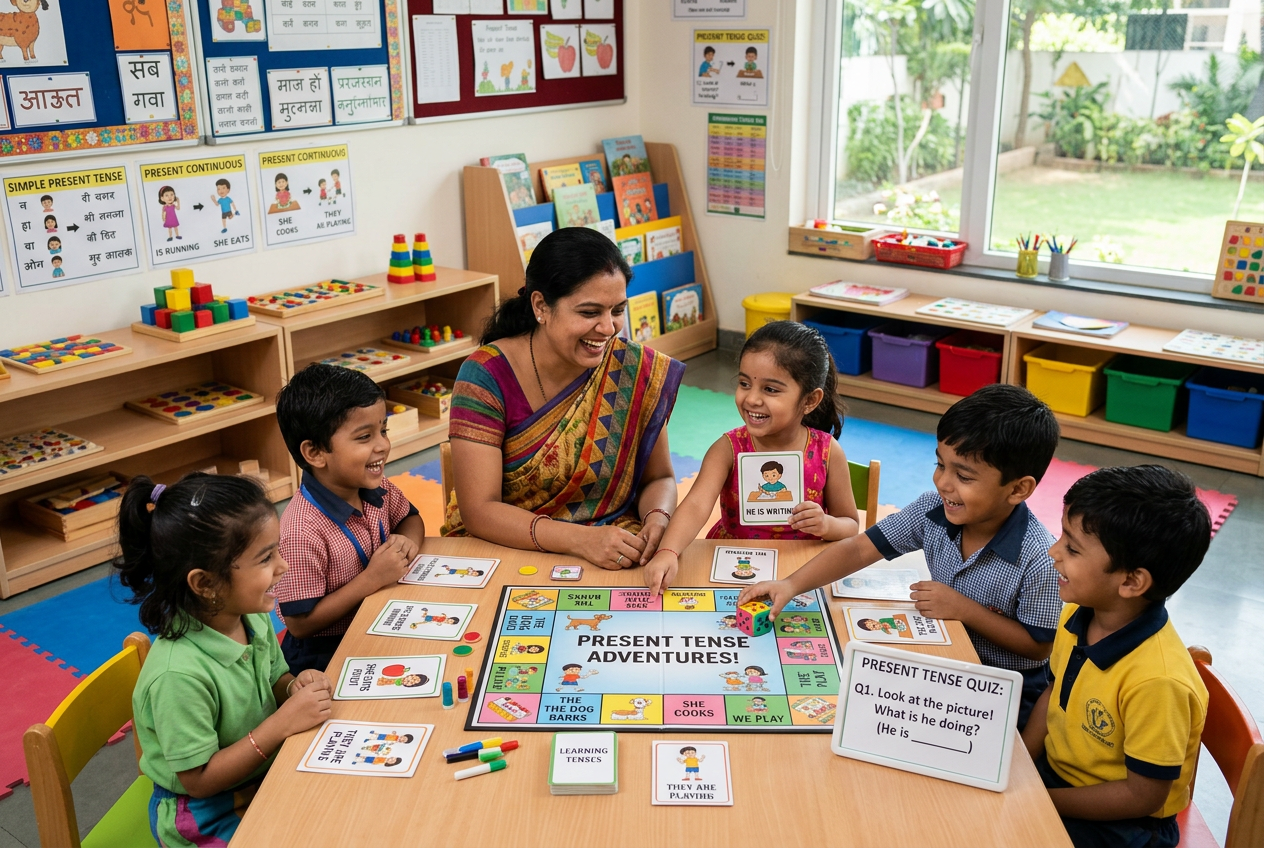
Teaching tenses becomes lot easier when kids engage actively instead of simply paying attentively. Simple and fun methods can help teachers to assist learners to better recall grammatical principles. These method help in improving memory and comprehension and make Grammar Practice a pleasurable pastime instead of a difficult job.
- Learning via reading tales: Students can understand how different tenses are used naturally in sentences by reading short stories. Changing the tense of a story also helps them easily notice language patterns.
- Quizzes and games about grammar: Board games, card games and short quizzes are fun and help children learn how to use the right tense.
- Speaking actions in real life: Asking students to speak about their daily routines, things that have happened in the past or goals for the future makes them feel more confident and accurate.
- Group activities and role play: Pair and group tasks promote communication and reduce fear of making mistakes.
- Visual aids and charts: Simple charts, timelines, and flashcards help learners connect form with meaning.
Teachers who want to strengthen their grammar teaching skills can join Vidhyanidhi Education Society (Govt. Regd.) offers Grammar Teacher Training course, this course focuses on practical classroom methods to make grammar easy and learner-friendly methods.

Source: magnific
How to Write a Lesson Plan for a Present Tense?
A lesson plan helps teachers teach language in a simple and correct method, keeping kids interested. When learning the present tense, the teacher should aim that the child understand the concept how to apply in real-life and use it with confidence. Start with easy learning objectives so that students understand what the present tense is and when to apply it. Keep goals simple and age appropriate.
Key elements of an effective lesson plan include:
- Introduction activity: Talk briefly about eating, studying, and playing. Students may relate grammar to actual life.
- Concept explanation: Explain present tense using simple phrases and recognizable verbs. Focus on examples, not extensive rules.
- Guided practice: Try worksheets, fill-in-the-blanks, or sentence creation. It helps kids apply rules appropriately.
- Interactive activities: Learning to talk with ease can be done through role plays, picture descriptions, and question–and–answer sessions. It’s easier to teach Present Tense in a clear and fun way with these tasks.
- Assessment and feedback: End the lesson with quick oral or written checks to see if learners can use the tense correctly.
- Revision and homework: Assign short practice tasks related to daily routines to strengthen understanding.
Vidhyanidhi Education Society (Govt. Regd.) offers Grammar Teacher Training Course for teachers who want to know about lesson planning and classroom management techniques. The course focuses on practical teaching methods and effective Teaching of Grammar.
Create fun tense lessons—join Grammar Course, Vidhyanidhi Education Society!
Click Here, to download the brochure of Grammar Course!
Call or Whatsapp on +918104606573 / +919869866277, for the details of Grammar Course!
FAQs
What Is The Hardest Tense To Learn In English?
The perfect continuous tenses are difficult to use due to the different verb forms, time references and the correct ways to speak and write them.
What Is The Rarest Tense In English?
The future perfect continuous tense is not used very often as it is only used in very specific time-based cases in formal writing.
Which Tense Is Used In Daily?
The present tense is most used in daily speech to express habits, facts, routines and regular actions.
What Is The Power Of The Present Tense?
It makes the communication clear and immediate; teachers trained at Vidhyanidhi Education Society learn to use it effectively.
